
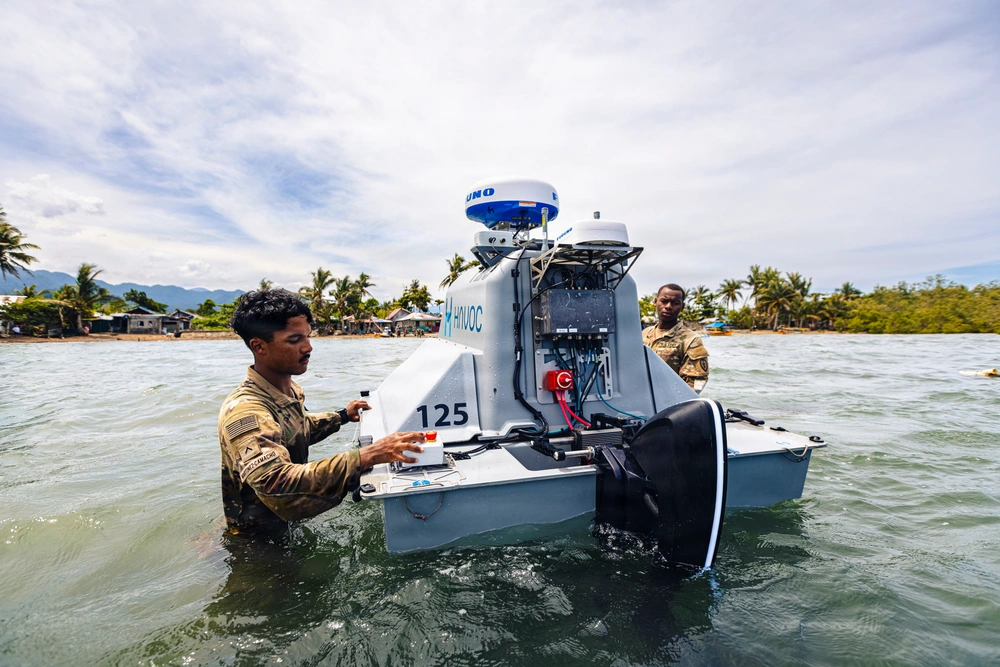
U.S. and Philippine Army forces conducted a maritime screen operation using a swarm of autonomous surface vessels (USVs) during Salaknib 2026, demonstrating how unmanned systems can extend situational awareness and reduce risk in contested maritime environments.
The operation took place in Casiguran Sound in the Philippines, as DVIDS reported. Soldiers from the 125th Intelligence and Electronic Warfare Battalion, 25th Infantry Division deployed a formation of USVs to establish a security perimeter as a U.S. Army Logistics Support Vessel transported Philippine Army armored personnel carriers along a 260-mile route from Port Tobaco to Port Casiguran. The autonomous boats spread across a wide area around the vessel as it transited the sound, with onboard sensors continuously monitoring the environment and relaying data to onshore personnel in near real time.

The mission directly showcased use cases central to Havoc’s autonomous maritime platform — the company behind the USVs deployed during the exercise. Havoc’s software suite is designed to enable a single operator to supervise large numbers of autonomous assets simultaneously through a one-to-many C2 interface, with its Havoc OS running edge autonomy on each vessel and Havoc Connect maintaining data exchange even in degraded or denied communications environments.
The operational impact was significant at the command level. “With the information the USV provides, the commander’s decision-making process has been compressed from hours to seconds,” said Ben Outlaw, an industry partner representative present during the operation. Soldiers operating the systems described the exercise as providing direct experience integrating advanced autonomy into a multinational context. “They escorted the LSV to port from about six miles out, allowing Philippine vehicles to roll onto the dock,” said Pvt. Caleb Hannah of the 125th IEWB.
For the defence industry, the Salaknib exercise adds to a growing body of operational evidence that autonomous maritime systems are moving from experimental platforms into routine combined-arms integration — with interoperability across allied C2 networks emerging as a key capability requirement alongside raw platform performance.